

Buprenorfin
Buprenorfin is an opioid analgesic indicated for the management of mild to moderate pain and postsurgical pain in dogs and cats. Buprenorphine acts primarily as a partial agonist of μ-opioid receptors in the central nervous system. It has a high affinity for these receptors and slow dissociation, characteristics that help prolong its analgesic effect.
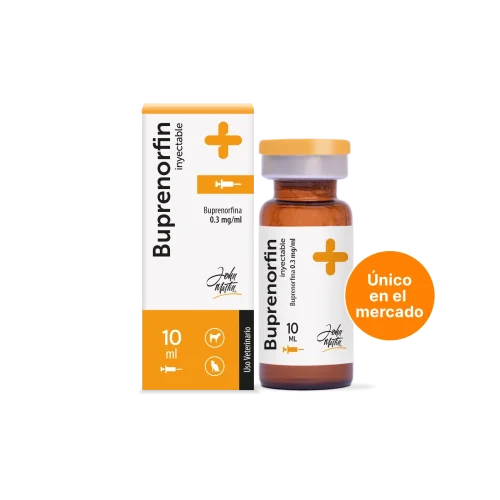
TARGET SPECIES
DOSAGE FORM
HOW SUPPLIED
DIFFERENTIATORS
BENEFITS AND COMPETITIVE ADVANTAGES
Lower risk of respiratory depression compared to full agonists.
Longer duration of effect compared to other opioids such as butorphanol.
Lower risk of respiratory depression compared to full agonists.
High cardiorespiratory stability in anesthetic protocols.
TECHNICAL DETAILS
Information
COMPOSITION
– Excipients q.s. to 1 ml.
DOSAGE AND ADMINISTRATION
– Dogs: Analgesic: 0.01 to 0.03 mg/kg IV or IM every 6 to 12 hours. Postsurgical analgesic: 0.01 to 0.02 mg/kg IV or IM. If additional pain relief is needed, an extra dose of 0.01 mg/kg may be given after 3 to 4 hours, or 0.02 mg/kg after 5 to 6 hours. The first dose is suggested approximately 1 hour before surgery.
– Cats: Analgesic: 0.01 to 0.03 mg/kg IM or IV every 6 to 8 hours. Postsurgical analgesic: 0.01 to 0.03 mg/kg IM or IV, repeated if necessary after 1 to 2 hours. The first dose is suggested approximately 1 hour before surgery.
Treatment duration may extend up to 3 days, at the discretion of the attending veterinary professional based on the patient's clinical progress.
- Joint Health
- Opioid Pain Management
- NSAID Pain Management
- Neuropathic Pain
- Steroidal Anti-inflammatory Drugs
- Antibiotics
- Gastrointestinal Health
- Hepatic Health
- Integrative Functional Supplementation
- Vitamins and Minerals
- Omega
- Laxatives
- Anticholinergic – Antispasmodics
- Hemostatic Agents
- Internal Antiparasitics
- External Antiparasitics
- Hemostatic Agent
Buprenorfin
TARGET SPECIES
DOSAGE FORM
HOW SUPPLIED
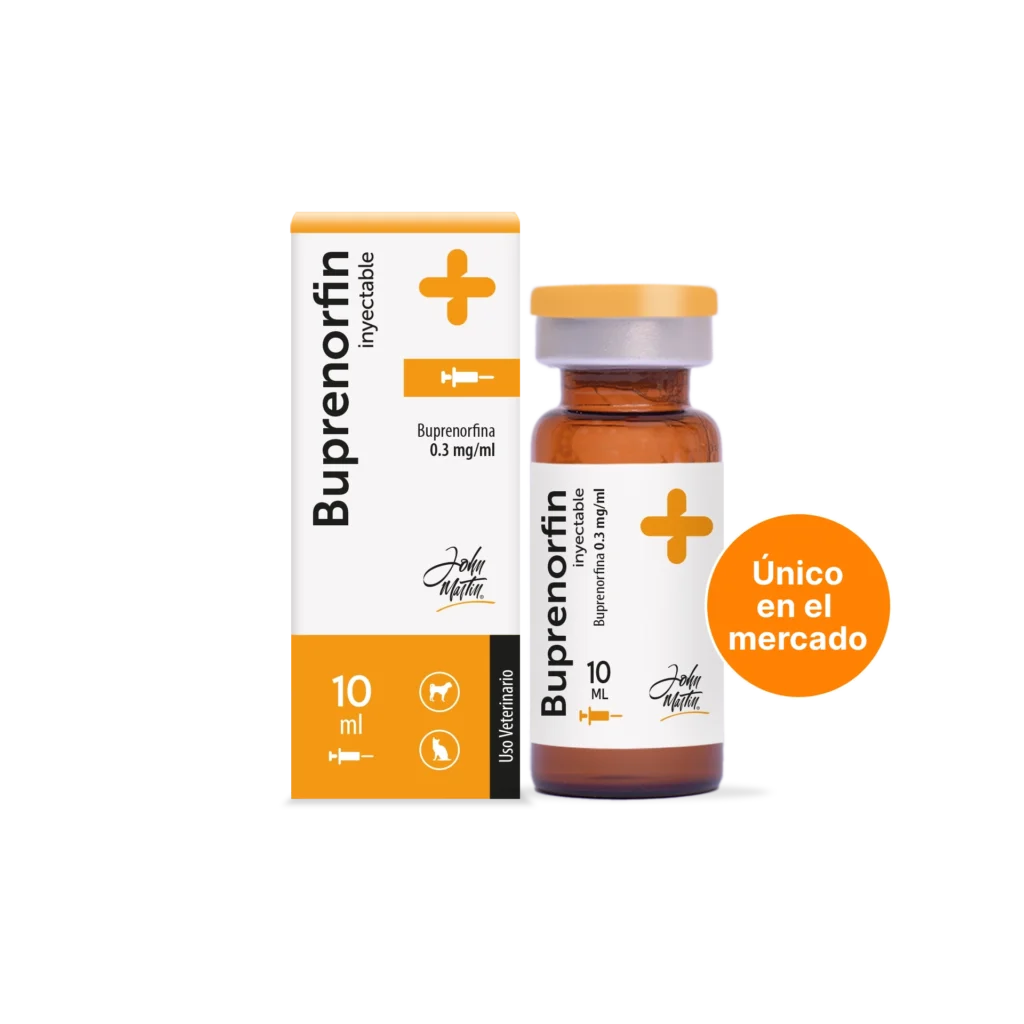
Buprenorfin is an opioid analgesic indicated for the management of mild to moderate pain and postsurgical pain in dogs and cats. Buprenorphine acts primarily as a partial agonist of μ-opioid receptors in the central nervous system. It has a high affinity for these receptors and slow dissociation, characteristics that help prolong its analgesic effect.
Lower risk of respiratory depression compared to full agonists.
Longer duration of effect compared to other opioids such as butorphanol.
Lower risk of respiratory depression compared to full agonists.
High cardiorespiratory stability in anesthetic protocols.
TECHNICAL DETAILS
Information
COMPOSITION
– Excipients q.s. to 1 ml.
DOSAGE AND ADMINISTRATION
– Dogs: Analgesic: 0.01 to 0.03 mg/kg IV or IM every 6 to 12 hours. Postsurgical analgesic: 0.01 to 0.02 mg/kg IV or IM. If additional pain relief is needed, an extra dose of 0.01 mg/kg may be given after 3 to 4 hours, or 0.02 mg/kg after 5 to 6 hours. The first dose is suggested approximately 1 hour before surgery.
– Cats: Analgesic: 0.01 to 0.03 mg/kg IM or IV every 6 to 8 hours. Postsurgical analgesic: 0.01 to 0.03 mg/kg IM or IV, repeated if necessary after 1 to 2 hours. The first dose is suggested approximately 1 hour before surgery.
Treatment duration may extend up to 3 days, at the discretion of the attending veterinary professional based on the patient's clinical progress.